
We Work with Architects — And It Changes Everything
In many parts of the country, architects bring in dedicated technology designers early in the process.
In Denver, that’s still rare.
More often, technology is introduced after framing—when the structure is already defined, materials are ordered, and the opportunity to do things the right way has passed.
That’s where we come in.
We work with architects from the beginning, acting as the bridge between design intent and the technology that supports it. Because in a modern luxury home, technology isn’t an add-on—it’s infrastructure.
Think of it this way:
An integrator is the general contractor of technology.
And just like any other system in the home, the earlier it’s considered, the better the outcome.
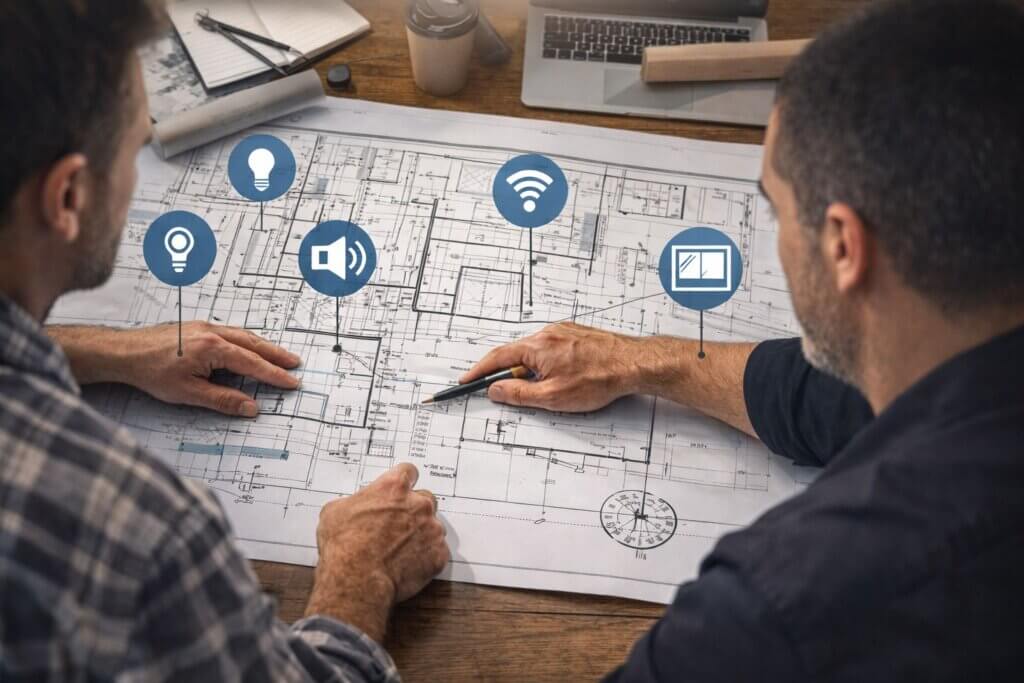
Protecting the Architect’s Vision (Not Fighting It Later)
Architects spend an enormous amount of time refining sightlines, materials, and spatial balance.
Then technology shows up late—and starts punching holes in it.
You’ve seen it:
- Walls cluttered with mismatched switches
- Speakers placed wherever there’s room
- Equipment shoved into closets that were never meant for it
This is where early collaboration matters.
When we work with architects early, we can:
- Plan for flush-mounted or hidden controls
- Align speaker placement with ceiling design
- Create dedicated equipment spaces before square footage is spoken for
The result isn’t just cleaner—it’s intentional.
And that matters to clients who notice everything.
Designing Infrastructure Before It Becomes a Problem
Luxury homes today require more than just wiring—they require planning.
Motorized shades are a perfect example.
If window pockets aren’t designed early, there may not be enough space to conceal them. That leads to exposed hardware and compromised design.
The same goes for:
- Dedicated theater construction (acoustic isolation, wall mass)
- Network infrastructure (access point placement, wiring paths)
- Lighting systems that require centralized control
These aren’t “technology decisions.”
They’re architectural decisions—whether they’re treated that way or not.
Lighting Has Become Part of the Architecture
Lighting is no longer just functional—it shapes how a home feels throughout the day.
We’re now designing lighting that:
- Supports natural daily rhythms
- Changes color temperature from morning to evening
- Enhances materials rather than flattening them
But none of that works if the system isn’t coordinated early.
Without planning, you end up with:
- Incompatible fixtures
- Overloaded wall clutter
- Missed opportunities to simplify control
With the right collaboration, a wall that would have had six switches becomes one clean keypad—or disappears entirely.
Avoiding Expensive Mid-Construction Fixes
There’s a simple rule in construction:
The later something is addressed, the more expensive it becomes.
Running wire before drywall is straightforward.
Doing it after?
Now you’re cutting, patching, repainting—and still compromising placement.
The same applies to:
- Power requirements for centralized systems
- Equipment locations
- Network infrastructure
Homeowners feel this immediately.
When technology isn’t planned early, it leads to:
- Frustration with performance
- Visible compromises in design
- Systems that don’t work the way they expected
And unfortunately, that frustration often gets directed at the architect—whether it started there or not.
Future-Proofing the Home (Without Touching It Again)
Technology evolves every few years.
The home should not.
That’s why early planning includes things like:
- Conduit pathways for future upgrades
- Strategic wiring beyond current needs
- Infrastructure that allows change without demolition
Because the most common regret homeowners have isn’t what they installed…
…it’s what they didn’t plan for.
The Handoff Moment Matters More Than People Think
There’s a moment at the end of every project where everything is judged.
Not the drawings.
Not the construction timeline.
The experience.
Does the lighting feel right?
Does the network actually work everywhere?
Do the window treatments behave the way the client expects?
If not, the home still feels unfinished.
And that final impression carries weight—for everyone involved.
Why This Matters in Denver Right Now
In markets like Aspen or Vail, it’s common to bring in dedicated technology designers early. At a cost – which on complicated projects that are intended to go out to bid makes sense.
In Denver, that layer is often missing.
So the responsibility falls to someone.
We’ve built our process around working directly with architects to fill that gap—early, collaboratively, and with respect for the design.
Not as an add-on.
As part of the team.
Final Thought: Better Homes Start Earlier
The best projects don’t feel like systems layered on top of architecture.
They feel cohesive. Intentional. Effortless.
That doesn’t happen by accident.
It happens when the right people are involved at the right time.
We work with architects because that’s where the difference is made.
If you are an architect or researching to build a new home, reach out. We would love to help.
When should an integrator be involved in a custom home project?
Ideally during the conceptual or schematic design phase, before framing begins.
Why do architects work with technology integrators?
To protect design intent, reduce wall clutter, and ensure systems are properly integrated into the structure.
What happens if technology is added too late?
It often leads to visible compromises, higher costs, and reduced performance.
Is this common in Denver?
Less than in resort markets like Aspen or Vail, which is why early collaboration is often overlooked.